Sound in
Play anything on your PC. CYMATIK listens to Windows system audio, or you can load an audio file.
Design a reality.
Let sound disturb it.
See what happens.
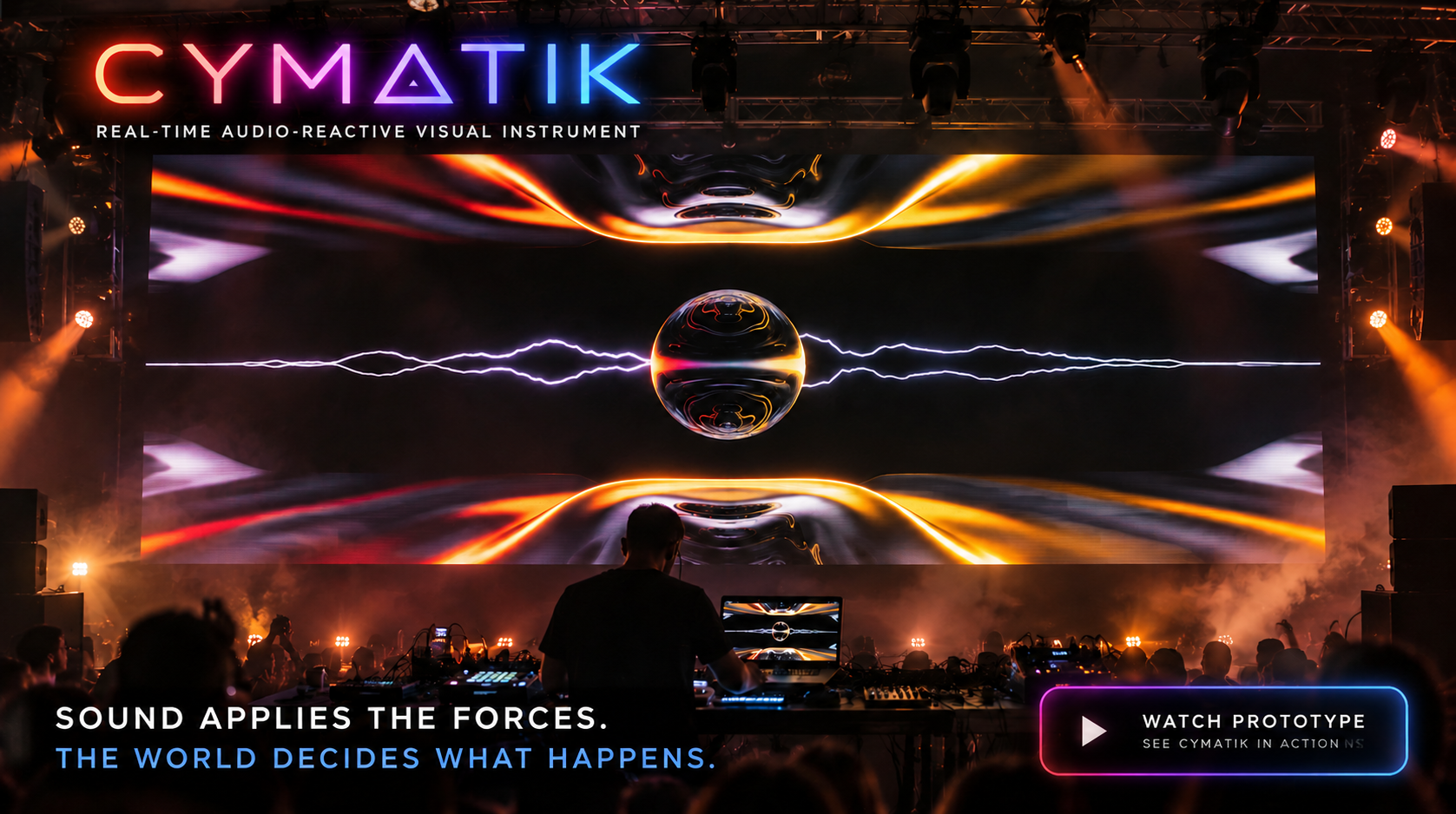
The demo video above is an earlier prototype capture. The worlds, materials and tools below describe the current Windows build, which is in private beta. Updated footage is on the way.
CYMATIK: Physics Lab is a real-time audiovisual instrument. Choose a world, decide what it is made of, and play any audio through it. Every hit leaves a mark that spreads, meets the next one and fades on its own.
Music supplies the forces. Physics determines the behavior. You explore the consequences.
Play anything on your PC. CYMATIK listens to Windows system audio, or you can load an audio file.
A surface, a tunnel and experimental twin-surface worlds. Each one is a persistent space that remembers what struck it.
Dots, membrane, clay and metal. Change material in the middle of a ripple and the wave carries on.
Four camera shots, with live control of force, physics, appearance and color.
The base world. One persistent surface stretching to the horizon.
Two opposing surfaces, each with its own persistent state. Events can go to one, the other, both, or alternate between them.
The FLATZ pair turned vertical, so the world rises on either side of you.
A tunnel. The world wraps around the viewer, and the circumference becomes part of the instrument.
A dense field of points. Depth comes from perspective and occlusion alone.
A continuous membrane with its own hue. Light follows the shape of the wave.
A matte, sculptural body. Form without shine.
The same body in reflective metal.
Chrome that reflects the room around it and the structure inside it.
Experimental items are marked. They work today, and they are still being shaped.
Every control belongs to one of five systems. Together they follow the path from the force that enters the world to the color you finally see.
How energy enters the world.
The forces and impulses that drive the simulation. Choose where they land, how they are shaped, and how hard they hit.
How the world responds.
Propagation, dispersion, damping and domain. The same strike can ring clean, smear into shimmer, or die away.
What the world is made from.
ExperimentalPlace a physical structure inside the world. It has its own physics and its own memory, and the same events strike it.
How the world is rendered.
Point surface, camera and depth. Stand inside the world, move through it, and decide how much of it you see.
How the world gets its visual identity.
Live control of hue, automatic color motion, and the lit room that reflective materials mirror.
Appearance and color change how the world is seen. They never change its physics, and nothing in them can erase the world's state.
Most audio visuals turn loudness into a visual parameter. CYMATIK can instead let sound strike a world whose circumference is part of the physics. In the TNLZ tunnel world, three controls decide how that circle behaves.
Dispersion and damping then decide how each strike travels and fades. The world keeps its state, so every strike leaves a consequence that spreads, interferes with the next one, and dies away on its own.
Real-time reflective-material research. CHRMZ asks whether worlds and structures can reflect one another, and the room around them, while the physics keeps moving.
Experimental. Reflection behavior is still being refined, and CHRMZ is not a finished material.
Controls in the current build
You don't need to be a musician. You don't need to be a visual artist. You don't need to understand the physics. You need curiosity and the desire to play.
Every control stays live while the world runs. Steer it from your hardware, recall a whole setup from a preset slot, record your own moves, and send a clean picture to the room.
Every parameter stays playable during the performance. Move a slider and the world answers while it is still moving.
Touch a CYMATIK control, move a knob on your controller, and the two are paired. Maps can be saved and recalled.
Twelve slots hold the whole setup: world, material, force shape, physics, camera and appearance. Name them and recall them.
Record how you move the controls, then play the motion back, pause it or loop it. AUTOM8 keeps your control moves, not picture or sound. For video, see RenderLab below.
Open Output creates a second window that carries the world and nothing else: no header, no tabs, no cards, no read-outs. Place it on a projector or display and double-click for full screen.
It is a second view of the same world, not a second world. Each surface frames the world for its own shape, built for widescreen and ultrawide displays and tested on a 32:9 ultrawide.
Spout output is being built so CYMATIK's picture can be shared with other Spout-capable video software on the same Windows PC.
It is not part of the current private beta. There is no release date yet, and compatibility with specific VJ software is not confirmed.
From sound to social. From performance to production.
RenderLab records your performance, then renders it again offline as a clean video master. You choose the shape afterwards, so one performance can become a widescreen video for your site and a portrait video for Reels, Shorts or TikTok.
Play your set and press record. RenderLab keeps what the world did and the audio Windows was playing. A quick preview video is ready seconds after you stop.
Pick widescreen, ultrawide, square, 4:5 or 9:16, a size and a frame rate. Enter your own size if you need one.
RenderLab rebuilds the performance frame by frame, offline, and writes an MP4 with a lossless audio file beside it.
Open the MP4 in your video editor to trim, add captions or titles, and upload it to your site or your social platforms.
For 9:16, 4:5 and 1:1, RenderLab moves CYMATIK's camera to fit the new shape instead of stretching the picture. A vertical FLATZ world, and narrow shapes from takes that use Event Horizon or OZL8, fall back to a letterboxed or center-cropped frame. For the best result, record in a window shaped like your finished video.
RenderLab is in private beta and is planned for CYMATIK 1.0.
CYMATIK: Physics Lab is a Windows instrument from Lotus Labz. It is in private beta, and commercial release is coming soon. Nothing is available to buy or download yet.
What this page describes.
Not yet released.
Marked on this page.
Planned, not yet available.
Visuals that follow a track or a set, without building a visual show from scratch.
A responsive world meant to be steered with hardware controls and recorded moves.
Turn a performance into video for music promotion, your website and your portfolio.
A clean output window for wide screens and projectors, built for widescreen and ultrawide shapes.
Not yet. The Windows build of CYMATIK: Physics Lab is in private beta, and commercial release is coming soon. Experimental features are marked on this page.
Not yet. Nothing can be purchased or downloaded today. A 14-day trial is planned, along with a $149 perpetual license. The planned introductory price is $99 for the first 30 days after launch. Lotus Labz will announce availability when the release is ready.
RenderLab can render 9:16 portrait video, with the exceptions listed in the RenderLab section. It does not trim, caption or post. Open the MP4 in your video editor to finish it and upload it to the platform you use.
Windows Spout output is in development. It is not released, and compatibility with specific VJ software has not been confirmed yet. Lotus Labz will say so here once it is.
Windows 11 and an NVIDIA graphics card are recommended, based on current testing. Final system requirements are pending validation, and no performance guarantees are published yet.
CYMATIK is being built for Windows. Other platforms and plugin formats are not announced.
Yes. It was recorded from the running software, with the audio you hear driving the visuals. It is an earlier prototype capture, and updated footage is planned.
No. The physics is the engine, not the interface. You only need curiosity.
CYMATIK is in private beta, with commercial release coming soon. Watch the prototype, follow along, or get in touch to collaborate.